Top 40 must-know 꼭 알아야 할 40가지
- Agricultural hearth — origin center where domestication of plants and animals first independently occurred. 농업 발상지 — 동식물 작물화가 독립적으로 처음 일어난 기원 중심지. [U5 p4]
- Bountiful Hypothesis (Carl Sauer) — agriculture began in bountiful environments, not from desperation or starvation. 풍요 가설(칼 사우어) — 농업은 절박함이나 굶주림이 아니라 자원이 풍부한 환경에서 시작되었다. [U5 p4]
- First Agricultural Revolution (Neolithic) — hunting and gathering to farming, right after the last Ice Age (around 10,000 BCE). 제1차 농업혁명(신석기 혁명) — 수렵·채집에서 농경으로의 전환, 마지막 빙하기 직후(약 기원전 10,000년). [U5 p5]
- Fertile Crescent — SW Asia, the most significant agricultural hearth; founder crops include emmer wheat, einkorn wheat, barley, flax. 비옥한 초승달 지대 — 서남아시아, 가장 중요한 농업 발상지; 시조 작물은 에머 밀·외알 밀·보리·아마. [U5 p5,U5 p7]
- Plant domestication and animal husbandry — deliberate selection and breeding; animals gave meat, milk, hides, draft power, manure. 식물 작물화와 가축 사육 — 의도적 선택과 육종; 가축은 고기·젖·가죽·견인력·거름을 제공. [U5 p9]
- Second Agricultural Revolution — with the Industrial Revolution; mechanization, crop rotation, enclosures; higher yields and urban migration. 제2차 농업혁명 — 산업혁명과 동시; 기계화·윤작·인클로저; 더 높은 수확량과 도시로의 이주. [U5 p12]
- Third (Green) Revolution — HYV seeds, synthetic fertilizers, pesticides, modern irrigation; Norman Borlaug. ⚠ Slides give two date ranges. 제3차(녹색) 혁명 — HYV 종자, 합성비료, 농약, 현대 관개; 노먼 볼로그. ⚠ 슬라이드에 연대 표기가 두 가지(단정 금지). [U5 p12,U5 p60]
- Intensive vs extensive — high inputs per unit of land (near markets, expensive land) vs low inputs over vast land (cheaper land). 집약 대 조방 — 단위 면적당 투입 많음(시장 근처, 비싼 땅) 대 넓은 땅에 투입 적음(싼 땅). [U5 p13]
- Subsistence agriculture — food for direct consumption and survival of the farmer's family; mainly LDCs; low capital, high labor; small scale. 자급농업 — 농부 가족의 직접 소비와 생존용; 주로 LDC; 저자본·고노동; 소규모. [U5 p14]
- Commercial agriculture — large-scale production for off-farm sales and profit; MDCs and agribusiness; high capital, low labor. 상업농 — 농장 밖 판매와 이윤을 위한 대규모 생산; MDC와 농업 기업; 고자본·저노동. [U5 p20]
- Shifting cultivation — use a plot until the soil is depleted, then move on; includes slash-and-burn; tropical (A climate) regions. 이동경작 — 토양이 소진될 때까지 쓰고 다른 땅으로 이동; 화전 포함; 열대(A 기후) 지역. [U5 p17]
- Pastoral nomadism — herding domesticated animals for food, clothing, shelter; dry climates; transhumance = seasonal livestock move between mountains and lowlands. 유목 — 식량·의복·주거를 위해 가축을 방목; 건조 기후; 이목(transhumance) = 산과 저지대 사이 계절적 가축 이동. [U5 p18]
- Wet rice dominant — E and SE China, India; labor-intensive, whole family, double cropping. 벼농사 우세 — 중국 동부·남동부, 인도; 노동 집약적, 온 가족 참여, 이모작. [U5 p19]
- Von Thünen model — agricultural patterns explained by land rent (bid-rent) and transportation costs. 튀넨 모델 — 토지 지대(입찰 지대)와 운송비로 농업 패턴을 설명. [U5 p21]
- Isolated state assumptions — single self-sufficient market, consistent soil and climate, flat land, direct route, cost proportional to distance. 고립국 가정 — 자급적 단일 시장, 균일한 토양·기후, 평탄한 땅, 직선 경로, 운송비는 거리에 비례. [U5 p22]
- Von Thünen rings — 1 dairying and horticulture, 2 forestry/firewood, 3 field crops and grains, 4 livestock ranching. 튀넨 고리 — 1 낙농·원예, 2 임업·땔감, 3 밭작물·곡물, 4 목축. [U5 p21]
- Mixed crop and livestock — crops (corn, soybeans) fed directly to animals; revenue mostly from livestock; Corn Belt, Western Europe. 혼합 농업 — 작물(옥수수·콩)을 가축에 직접 먹임; 수입 대부분이 축산물; 콘 벨트·서유럽. [U5 p30]
- Dairy farming — perishable products make market proximity critical; milkshed = ring around a city supplying milk without spoiling (Ring 1). 낙농 — 상하기 쉬워 시장 근접이 중요; 밀크셰드 = 우유가 상하지 않고 공급되는 도시 둘레 고리(1고리). [U5 p36]
- Mediterranean agriculture — hot dry summers and mild wet winters; olives, grapes, citrus, figs, tree nuts. 지중해성 농업 — 덥고 건조한 여름과 온화한 습한 겨울; 올리브·포도·감귤·무화과·견과. [U5 p38]
- Commercial gardening (truck farming) — fresh fruits, vegetables, flowers for urban markets; capital- and labor-intensive. 상업적 원예(트럭 농업) — 도시 시장용 신선 과일·채소·꽃; 자본·노동 집약적. [U5 p41]
- Commercial grain farming — mainly wheat; extreme mechanization; low yield per unit area but high output per worker; spring vs winter wheat belts. 상업적 곡물 농업 — 주로 밀; 극단적 기계화; 단위 면적당 수확은 낮고 노동자당 산출은 높음; 춘파·동파 밀 지대. [U5 p42]
- Livestock ranching — grazing cattle and sheep on arid or semi-arid land; low land rent; outermost Ring 4. 기업적 목축 — 건조·반건조지의 소·양 방목; 낮은 지대; 가장 바깥 4고리. [U5 p51]
- Plantation agriculture — monoculture of a single cash crop in tropical LDCs for export; colonial roots; vulnerable to price swings. 플랜테이션 — 열대 LDC에서 수출용 단일 환금작물 단일 재배; 식민지 기원; 가격 변동에 취약. [U5 p53]
- Columbian Exchange — Old World wheat, rice, coffee, sugarcane, horses, cattle to the New World; maize, potato, cassava, tomato, tobacco the other way. 콜럼버스 교환 — 구세계의 밀·쌀·커피·사탕수수·말·소가 신세계로; 옥수수·감자·카사바·토마토·담배가 반대로. [U5 p57]
- HYVs — high-yield varieties such as dwarf wheat, rice (IR8 "Miracle Rice"), corn. HYV(고수확 품종) — 왜성 밀, 쌀(IR8 "기적의 쌀"), 옥수수 등. [U5 p61]
- Green Revolution successes — cereals more than doubled 1960–1990; famines averted; food security up; staple prices lowered. 녹색혁명 성과 — 1960–1990 곡물 두 배 이상; 기근 방지; 식량 안보 향상; 주식 가격 하락. [U5 p62]
- Green Revolution limitations — salinization, aquifer depletion, biodiversity loss, wealth disparity, debt cycles, Sub-Saharan Africa left behind. 녹색혁명 한계 — 염류화, 대수층 고갈, 생물다양성 손실, 부의 격차, 부채 악순환, 사하라 이남 소외. [U5 p63]
- Food security — four pillars: availability, access, utilization, stability. 식량 안보 — 4대 기둥: 가용성, 접근성, 활용, 안정성. [U5 p64]
- Food desert — area with limited access to affordable, fresh, nutritious whole foods; low-income people relying on convenience-store processed food. 식량 사막 — 저렴·신선·영양 있는 식품 접근이 제한된 지역; 편의점 가공식품에 의존하는 저소득층. [U5 p64]
- Desertification — land degradation in arid, semi-arid, dry sub-humid areas; causes: overgrazing, deforestation, over-cultivation. 사막화 — 건조·반건조·건조 아습윤 지역의 토지 황폐화; 원인: 과방목·삼림 벌채·과경작. [U5 p65]
- Over-irrigation — salinization, aquifer depletion (Ogallala), water conflict (Aral Sea). 과잉 관개 — 염류화, 대수층 고갈(오갈랄라), 물 분쟁(아랄해). [U5 p66]
- Rural-to-urban migration — push (poverty, lost farm jobs, land scarcity, conflict) and pull (jobs, healthcare, education, amenities). 농촌-도시 이주 — 배출 요인(빈곤·농업 일자리 상실·토지 부족·분쟁)과 흡인 요인(일자리·의료·교육·편의). [U6a p5]
- Suburbanization causes — automobile ownership, Interstate Highway Act of 1956, larger homes, lower land costs, mortgage policy and zoning. 교외화 원인 — 자동차 소유, 1956 주간 고속도로법, 더 큰 집, 낮은 지가, 모기지 정책·zoning. [U6a p9]
- Urban sprawl — unrestricted, low-density expansion with minimal centralized planning. 도시 스프롤 — 중앙 계획이 거의 없는 제한 없는 저밀도 확장. [U6a p10]
- Sprawl mitigation — Smart Growth and New Urbanism: mixed-use, walkable, TOD, urban growth boundaries (greenbelts). 스프롤 완화 — 스마트 성장·신도시주의: 복합 용도, 보행 친화, TOD, 도시 성장 경계(그린벨트). [U6a p11]
- Megacity > 10 million; metacity > 20 million. 메가시티 > 1천만; 메타시티 > 2천만. [U6a p12]
- Bid-rent theory (Alonso) — land near the CBD costs most; rent falls with distance (retail steepest, residential flattest). 입찰 지대 이론(알론소) — CBD 근처 땅이 가장 비쌈; 거리에 따라 지대 하락(소매 가장 가파름, 주거 가장 완만). [U6b p3,U6a p22]
- Burgess concentric zone model (1925) — US city of 1900–1950; five concentric zones with the CBD (zone 1) at the center. 버제스 동심원 지대 모델(1925) — 1900–1950년 미국 도시; CBD(1구역)를 중심에 둔 5개 동심원 지대(CBD 포함 5개). [U6b p6]
- Invasion and succession — an incoming group enters, competes, and completely replaces the previous group. 침입과 계승 — 들어온 집단이 경쟁하고 이전 집단을 완전히 대체. [U6b p11]
- Filtering down vs filtering up (gentrification) — housing passes down to lower-income groups as it ages; gentrification: a formerly low-income neighborhood comes to be coveted by wealthier inhabitants. 하향 여과 대 상향 여과(젠트리피케이션) — 주택이 낡으며 저소득층에게 넘어감; 젠트리피케이션은 예전 저소득 동네를 더 부유한 주민들이 탐내게 됨. [U6b p12,U6b p13,U6b p19]
10 comparison tables 비교표 10개
1. Subsistence vs commercial 자급농업 대 상업농
| Item 항목 | Subsistence 자급 | Commercial 상업 |
|---|---|---|
| Region 지역 | Mainly LDCs 주로 LDC | MDCs and global agribusiness MDC와 글로벌 농업 기업 |
| Purpose 목적 | Direct consumption and survival of the family 가족의 직접 소비·생존 | Off-farm sales and profit maximization 농장 밖 판매·이윤 극대화 |
| Inputs 투입 | Low capital, high labor 저자본·고노동 | High capital, low labor 고자본·저노동 |
| Scale 규모 | Small landholdings, little surplus 소규모 토지, 잉여 거의 없음 | Large-scale; monoculture by agribusiness 대규모; 기업의 단일 재배 |
2. Intensive vs extensive 집약 대 조방
| Item 항목 | Intensive 집약 | Extensive 조방 |
|---|---|---|
| Inputs 투입 | High labor/capital per unit of land 단위 면적당 노동·자본 많음 | Low labor/capital relative to vast land 넓은 땅에 비해 노동·자본 적음 |
| Location 입지 | Near markets or expensive land 시장 근처, 비싼 땅 | Cheaper land 더 싼 땅 |
| Examples 예 | Market gardening, dairying, mixed crop/livestock, wet rice 상업적 원예(시장 원예), 낙농, 혼합 농업, 벼농사 | Shifting cultivation, nomadic herding, livestock ranching 이동경작, 유목, 기업적 목축 |
3. Three agricultural revolutions 세 번의 농업혁명
| Revolution 혁명 | Key change 핵심 변화 | Result 결과 |
|---|---|---|
| First (Neolithic) 제1차(신석기) | Hunting and gathering to farming; plant and animal domestication 수렵·채집에서 농경으로; 동식물 작물화 | Origin of hearths (e.g., Fertile Crescent) 발상지의 기원(예: 비옥한 초승달 지대) |
| Second 제2차 | With the Industrial Revolution; tractors, crop rotation, enclosures 산업혁명과 동시; 트랙터·윤작·인클로저 | Higher yields and urban migration 더 높은 수확량과 도시 이주 |
| Third (Green) 제3차(녹색) | HYV seeds, synthetic fertilizers, pesticides, modern irrigation HYV 종자, 합성비료, 농약, 현대 관개 | More food in LDCs, but environmental and inequality problems LDC 식량 증가, 그러나 환경·불평등 문제 |
4. Von Thünen rings 튀넨 고리
| Ring 고리 | Land use 토지 이용 | Reason 이유 |
|---|---|---|
| 1 1 | Dairying and horticulture 낙농·원예 | Highly perishable, high transport cost 상하기 쉽고 운송비 높음 |
| 2 2 | Forestry/firewood 임업·땔감 | Heavy to transport 운반이 무거움 |
| 3 3 | Field crops and grains 밭작물·곡물 | Less perishable, easier transport 덜 상하고 운송 쉬움 |
| 4 4 | Livestock ranching 목축 | Requires vast land; animals walk to market 넓은 땅 필요; 가축이 걸어서 시장으로 |
5. 7 types of commercial agriculture 상업농 7유형
| Type 유형 | Key feature 핵심 특징 | Key regions 주요 지역 |
|---|---|---|
| Mixed crop and livestock 혼합 농업 | Crops fed to animals; livestock revenue; even income through the year 작물을 가축에 먹임; 축산 수입; 연중 고른 소득 | U.S. Corn Belt, Western Europe 미국 콘 벨트, 서유럽 |
| Dairy 낙농 | Perishable; milkshed in Ring 1 상하기 쉬움; 1고리의 밀크셰드 | NE United States, Western Europe, New Zealand 미국 북동부, 서유럽, 뉴질랜드 |
| Mediterranean 지중해성 | Hot dry summer, wet winter; tree crops 덥고 건조한 여름·습한 겨울; 수목 작물 | Mediterranean Basin, California, Central Chile 지중해 연안, 캘리포니아, 칠레 중부 |
| Commercial gardening 상업적 원예 | Fresh produce for urban markets; cold chain 도시 시장용 신선 농산물; 냉장 유통 | California, Florida, Netherlands 캘리포니아, 플로리다, 네덜란드 |
| Grain 곡물 | Wheat; extreme mechanization; low yield per area, high per worker 밀; 극단적 기계화; 면적당 수확 낮고 노동자당 높음 | Great Plains, Ukraine/Russia/Kazakhstan steppes, Pampas 대평원, 우크라이나·러시아·카자흐스탄 스텝, 팜파스 |
| Livestock ranching 기업적 목축 | Arid land, low rent, Ring 4 건조지, 낮은 지대, 4고리 | Western U.S., Pampas, Northern Australia 미국 서부, 팜파스, 호주 북부 |
| Plantation 플랜테이션 | Single cash crop for export in LDCs; colonial roots LDC의 수출용 단일 환금작물; 식민지 기원 | Latin America, Sub-Saharan Africa, South/Southeast Asia 라틴아메리카, 사하라 이남, 남·동남아시아 |
6. Extensive subsistence vs intensive subsistence 조방 자급 대 집약 자급
| Type 유형 | Key feature 핵심 특징 | Where 지역 |
|---|---|---|
| Shifting cultivation 이동경작 | Plot used until soil depleted; slash-and-burn 토양 소진 때까지 사용; 화전 | Latin America, Central Africa, SE Asia 라틴아메리카, 중앙아프리카, 동남아시아 |
| Pastoral nomadism 유목 | Herding camels, goats, sheep, cattle; transhumance 낙타·염소·양·소 방목; 이목 | Central and SW Asia, North Africa 중앙·서남아시아, 북아프리카 |
| Wet rice dominant 벼농사 우세 | Labor-intensive, whole family, double cropping 노동 집약적, 온 가족, 이모작 | E and SE China, India 중국 동·남동부, 인도 |
| Rice not dominant 벼 비우세 | Wheat and barley; crop rotation; less consistent rainfall 밀·보리; 윤작; 강우 덜 일정 | Northern China 중국 북부 |
7. Green Revolution: successes vs limitations 녹색혁명: 성과 대 한계
| Success 성과 | Limitation 한계 |
|---|---|
| Cereals more than doubled 1960–1990 1960–1990 곡물 두 배 이상 | Salinization, topsoil loss, aquifer depletion, eutrophication 염류화, 표토 손실, 대수층 고갈, 부영양화 |
| Famines averted (South Asia, India's wheat) 기근 방지(남아시아, 인도 밀) | Monoculture replaced local varieties; pests and disease risk 단일 재배가 토종 품종 대체; 병해충 위험 |
| Self-sufficient producers or net exporters (India, Mexico, Philippines) 자급국·순수출국 전환(인도·멕시코·필리핀) | Wealth disparity; debt cycles 부의 격차; 부채 악순환 |
| Lower staple prices for the urban poor 도시 빈곤층의 주식 가격 하락 | Sub-Saharan Africa left behind: unsuitable crops, variable rainfall, poor infrastructure 사하라 이남 소외: 맞지 않는 작물·불규칙한 강우·열악한 기반 시설 |
8. Food security: four pillars 식량 안보: 4대 기둥
| Pillar 기둥 | Meaning 의미 |
|---|---|
| Availability 가용성 | Sufficient food production and supply 충분한 식량 생산과 공급 |
| Access 접근성 | Economic and physical ability to obtain food 식량을 얻을 경제적·물리적 능력 |
| Utilization 활용 | Proper food processing, nutrition, clean water access 적절한 식품 처리·영양·깨끗한 물 접근 |
| Stability 안정성 | Consistent availability and access over time without sudden shocks 충격 없이 시간이 지나도 일관된 가용성·접근성 |
9. Urbanization: MDCs vs LDCs 도시화: MDC 대 LDC
| Item 항목 | MDCs MDC | LDCs LDC |
|---|---|---|
| Urban percentage 도시 비율 | High percentage (typically 75–80%+) 높은 비율(보통 75–80% 이상) | Lower overall percentage 전체적으로 낮은 비율 |
| Growth rate 성장 속도 | Currently slow or stagnant 현재 느리거나 정체 | Speed and scale exceptionally high 속도와 규모가 매우 큼 |
| Problem 문제 | — — | Infrastructure cannot keep pace; informal settlements 기반 시설이 따라가지 못함; 비공식 정주지 |
10. Burgess five zones 버제스 5구역
| Zone (F28) 구역(F28) | Name 이름 | Key feature 핵심 특징 |
|---|---|---|
| 1 1 | Central business district 중심업무지구(CBD) | Peak land value, skyscrapers, commercial hub, transport focus 최고지가, 고층 건물, 상업 중심, 교통 집중 |
| 2 2 | Zone of transition 전이지대 | Mixed with industry, tenements, slums, new immigrants 산업과 혼재, 공동주택, 슬럼, 신규 이민자 |
| 3 3 | Zone of independent workers' homes 독립 노동자 주거지대 | Working-class zone (inner suburbs), close to CBD jobs 노동계급 구역(내부 교외), CBD 일터와 가까움 |
| 4 4 | Zone of better residences 더 나은 주거지대 | Middle-class zone (outer suburbs), newer, better amenities 중산층 구역(외부 교외), 더 새롭고 편의 좋음 |
| 5 5 | Commuter's zone 통근자 지대 | Richest, spacious housing, private-vehicle commuting 가장 부유, 넓은 주택, 자가용 통근 |
⚠ Zones 3·4·5 ↔ working-/middle-/upper-class zones: the slide headers on U6b p14–16 show the zone number and name ("3 Zone of independent workers' homes", "4 Zone of better residences", "5 Commuter's zone"), so this match is confirmed by the slides, not an editorial guess. (The headers are images, so they are not in the extracted slide text.)
⚠ 3·4·5구역 ↔ 노동자 계층·중산층·상류층 주거지대: U6b p14–16 슬라이드 머리글에 구역 번호와 이름("3 독립 노동자 주거지대", "4 더 나은 주거지대", "5 통근자 지대")이 표기되어 있으므로, 이 대응은 편집 판단이 아니라 슬라이드에서 확인된 것이다. (머리글은 이미지라 추출문에는 없다.)
25 look-alike pairs 함정 구분 25쌍
- Intensive ≠ extensive — cue: inputs per unit of land (high vs low). 집약 ≠ 조방 — 단서: 단위 면적당 투입(많음 대 적음).
- Subsistence ≠ commercial — cue: feed the family vs off-farm sales and profit. 자급 ≠ 상업 — 단서: 가족 식량용 대 농장 밖 판매·이윤.
- Shifting cultivation ≠ pastoral nomadism — cue: moving plots of crops vs herding animals. 이동경작 ≠ 유목 — 단서: 작물 재배 땅을 옮김 대 가축 방목.
- Wet rice dominant ≠ rice not dominant — cue: E/SE China and India vs wheat and barley in northern China. 벼 우세 ≠ 벼 비우세 — 단서: 중국 동·남동부·인도 대 중국 북부의 밀·보리.
- Mixed crop and livestock ≠ livestock ranching — cue: crops fed to animals on one farm vs grazing on arid land. 혼합 농업 ≠ 기업적 목축 — 단서: 한 농장에서 작물을 가축에 먹임 대 건조지 방목.
- Dairy ≠ livestock ranching — cue: Ring 1 (perishable) vs Ring 4 (vast land). 낙농 ≠ 기업적 목축 — 단서: 1고리(상하기 쉬움) 대 4고리(넓은 땅).
- Mediterranean agriculture ≠ commercial gardening — cue: olives, grapes in a Mediterranean climate vs fresh produce near cities. 지중해성 농업 ≠ 상업적 원예 — 단서: 지중해성 기후의 올리브·포도 대 도시 근처 신선 농산물.
- Plantation ≠ subsistence farming — cue: cash crop for export to MDC markets vs food for the family. 플랜테이션 ≠ 자급농업 — 단서: MDC 시장 수출용 환금작물 대 가족 식량.
- Monoculture ≠ intercropping — cue: single crop vs [보충] mixed crops (the slide only shows "Monoculture<-->Intercropping"; intercropping is not defined there). 단일 재배 ≠ 간작 — 단서: 한 작물 대 [보충] 여러 작물 혼합(슬라이드는 "Monoculture<-->Intercropping" 대비만 보여 주고 간작을 정의하지 않음).
- Spring wheat belt ≠ winter wheat belt — cue: Dakotas/Montana vs Kansas/Oklahoma/Texas. 춘파 밀 지대 ≠ 동파 밀 지대 — 단서: 다코타·몬태나 대 캔자스·오클라호마·텍사스.
- First ≠ Second agricultural revolution — cue: domestication vs mechanization with industry. 제1차 ≠ 제2차 농업혁명 — 단서: 작물화 대 산업혁명과 함께한 기계화.
- Second ≠ Third agricultural revolution — cue: tractors, enclosures vs HYV seeds, fertilizers (Green). 제2차 ≠ 제3차 농업혁명 — 단서: 트랙터·인클로저 대 HYV 종자·비료(녹색).
- Green Revolution success ≠ limitation — cue: yields and famine prevention vs salinization, debt, Africa left behind. 녹색혁명 성과 ≠ 한계 — 단서: 수확량·기근 방지 대 염류화·부채·아프리카 소외.
- Food security ≠ food desert — cue: four-pillar access to food in general vs areas lacking fresh, affordable food. 식량 안보 ≠ 식량 사막 — 단서: 4기둥의 식량 접근 대 신선하고 저렴한 식품이 부족한 지역.
- Desertification ≠ salinization — cue: land degradation from overgrazing/deforestation vs salts left by evaporating irrigation water. 사막화 ≠ 염류화 — 단서: 과방목·벌채로 인한 토지 황폐화 대 증발하는 관개수가 남긴 염분.
- Salinization ≠ aquifer depletion — cue: salts on the surface vs over-pumping groundwater (Ogallala). 염류화 ≠ 대수층 고갈 — 단서: 표면의 염분 대 지하수 과양수(오갈랄라).
- Old World → New World ≠ New World → Old World — cue: wheat, rice, horses vs maize, potato, tomato. 구세계→신세계 ≠ 신세계→구세계 — 단서: 밀·쌀·말 대 옥수수·감자·토마토.
- Von Thünen ≠ urban bid-rent (F27) — cue: farm rings around a market vs retail/manufacturing/residential rent from the CBD. 튀넨 ≠ 도시 입찰 지대(F27) — 단서: 시장 둘레의 농업 고리 대 CBD에서의 소매·제조·주거 지대.
- Urbanization ≠ suburbanization — cue: growing share of people in cities vs movement from cities to suburbs. 도시화 ≠ 교외화 — 단서: 도시 거주 비율 증가 대 도시에서 교외로 이동.
- Suburbanization ≠ urban sprawl — cue: movement of people vs unrestricted low-density land expansion. 교외화 ≠ 도시 스프롤 — 단서: 사람의 이동 대 제한 없는 저밀도 토지 확장.
- Megacity ≠ metacity — cue: > 10 million vs > 20 million. 메가시티 ≠ 메타시티 — 단서: 1천만 초과 대 2천만 초과.
- MDC ≠ LDC urbanization — cue: high percentage, slow growth vs fast growth, informal settlements. MDC ≠ LDC 도시화 — 단서: 높은 비율·느린 성장 대 빠른 성장·비공식 정주지.
- Push factor ≠ pull factor — cue: poverty, lost farm jobs (rural) vs jobs, healthcare, education (urban). 배출 요인 ≠ 흡인 요인 — 단서: 빈곤·농업 일자리 상실(농촌) 대 일자리·의료·교육(도시).
- Invasion ≠ succession — cue: a new group enters vs the group completely replaces the previous one. 침입 ≠ 계승 — 단서: 새 집단이 들어옴 대 이전 집단을 완전히 대체.
- Filtering down ≠ filtering up (gentrification) — cue: housing passes to lower-income groups vs wealthier inhabitants move in to / covet a formerly low-income neighborhood. 하향 여과 ≠ 상향 여과(젠트리피케이션) — 단서: 주택이 저소득층에게 넘어감 대 더 부유한 주민이 예전 저소득 동네로 들어옴(그 동네를 탐냄).
Essay skeletons for the 3 exam topics 서술형 3주제 답안 뼈대
Burgess concentric zone model 버제스 동심원 지대 모델
Sentence frames:
문장 틀:
- (a) The model was proposed by ___ in ___ and depicts the US city of ___. (a) 이 모델은 ___이(가) ___년에 제안했고 ___의 미국 도시를 묘사한다.
- (b) The CBD has the ___ land value because of high demand and central accessibility, so there are ___. (b) CBD는 높은 수요와 중심 접근성 때문에 지가가 ___하며, 그래서 ___가 있다.
- (c) As the CBD expands, it pushes into the Zone in Transition; in invasion ___, and in succession ___. (c) CBD가 확장하며 전이지대로 밀고 들어가고, 침입에서는 ___, 계승에서는 ___.
- (d) One criticism is ___ because ___ (Europe/Asia fortresses; Tokyo's mountains; gentrification). (d) 한 가지 비판은 ___이며 그 이유는 ___이다(유럽·아시아 요새; 도쿄의 산; 젠트리피케이션).
Keyword checklist:
필수 키워드 체크리스트:
- ☐ Burgess, 1925, US city 1900–1950 ☐ 버제스, 1925, 1900–1950 미국 도시
- ☐ CBD, peak land value intersection (PLVI) ☐ CBD, 최고지가교차점(PLVI)
- ☐ Zone in Transition, tenements, slums, new immigrants ☐ 전이지대, 공동주택, 슬럼, 신규 이민자
- ☐ invasion, competition, succession ☐ 침입, 경쟁, 계승
- ☐ 5 zones in order (1 CBD – 5 Commuter's zone) ☐ 5구역 순서(1 CBD – 5 통근자 지대)
- ☐ filtering down; gentrification ☐ 하향 여과; 젠트리피케이션
- ☐ criticisms: America-centric, geographical limits, gentrification ☐ 비판: 미국 중심, 지형 한계, 젠트리피케이션
Urban sprawl 도시 스프롤
Sentence frames:
문장 틀:
- (a) Urban sprawl is the unrestricted, ___ expansion of ___ over rural land with minimal ___. (a) 도시 스프롤은 최소한의 ___만 있는 상태에서 농촌 토지 위로 ___이(가) 제한 없이 ___ 확장하는 것이다.
- (b) Suburbanization, driven by ___ and ___ (U6a p9: automobile ownership, Interstate Highway Act of 1956, lower land costs, larger homes, mortgage/zoning), spreads low-density growth outward. (b) ___과 ___(U6a p9: 자동차 소유, 1956 주간 고속도로법, 낮은 지가, 더 큰 집, 모기지·zoning)에 이끌린 교외화가 저밀도 성장을 바깥으로 퍼뜨린다.
- (c) One negative impact is ___ because ___ (auto-dependency; loss of farmland; infrastructure costs). (c) 한 가지 부정적 영향은 ___이며 그 이유는 ___이다(자동차 의존; 농지 상실; 기반 시설 비용).
- (d) Smart Growth and New Urbanism reduce this through ___, which ___. (d) 스마트 성장과 신도시주의는 ___을 통해 이를 줄이며, 이는 ___한다.
Keyword checklist:
필수 키워드 체크리스트:
- ☐ unrestricted, low-density, minimal planning ☐ 제한 없음, 저밀도, 최소 계획
- ☐ automobile ownership; Interstate Highway Act of 1956 ☐ 자동차 소유; 1956 주간 고속도로법
- ☐ larger homes; lower land costs; mortgage policy and zoning ☐ 더 큰 집; 낮은 지가; 모기지 정책·zoning
- ☐ auto-dependency; prime agricultural land; infrastructure costs ☐ 자동차 의존; 우량 농지; 기반 시설 비용
- ☐ (suburbanization consequences, U6a p9) erosion of tax base / urban decay / white flight ☐ (교외화의 결과, U6a p9) 세수 기반 침식 / 도시 쇠퇴 / 백인 이탈
- ☐ mixed-use, walkable, TOD, urban growth boundaries (greenbelts) ☐ 복합 용도, 보행 친화, TOD, 도시 성장 경계(그린벨트)
2017 APHG FRQ Q3 (Green Revolution): A 1 / B 1 / C 2 / D 1 / E 1 2017 APHG FRQ 3번(녹색혁명): A 1 / B 1 / C 2 / D 1 / E 1
Sentence frames:
문장 틀:
- A: Two innovations are ___ and ___. A: 두 가지 혁신은 ___과 ___이다.
- B: It boosted food security by ___, which averted ___ and let ___ reach self-sufficiency. B: ___로 식량 안보를 높였고, 이는 ___을 막고 ___이(가) 자급에 이르게 했다.
- C: First, research focused on ___ and ignored ___. Second, Sub-Saharan Africa lacked ___. C: 첫째, 연구가 ___에 집중하고 ___을 무시했다. 둘째, 사하라 이남은 ___이 부족했다.
- D: ___ caused by over-irrigation; water evaporates, ___ build up on the surface, making land toxic. D: 과잉 관개로 ___이 생긴다; 물이 증발하면 ___이 표면에 쌓여 땅이 독이 된다.
- E: Small farmers must buy ___ every year; without ___ they fall into ___. E: 소농은 매년 ___을 사야 하고, ___이 없으면 ___에 빠진다.
Keyword checklist:
필수 키워드 체크리스트:
- ☐ HYVs, synthetic nitrogen fertilizers ☐ HYV, 합성 질소비료
- ☐ yields up in densely populated LDCs; famine averted; India wheat ☐ 인구 밀집 LDC 수확량 증가; 기근 방지; 인도 밀
- ☐ rice/wheat/maize focus; cassava, sorghum, yams ignored ☐ 쌀·밀·옥수수 중심; 카사바·수수·얌 무시
- ☐ transport, electricity, mechanized irrigation lacking ☐ 운송·전력·기계화 관개 부족
- ☐ salinization from over-irrigation (arid, evaporation, salts) ☐ 건조 지역 과잉 관개의 염류화(증발, 염분)
- ☐ expensive seeds, chemicals, fuel; credit/subsidies; debt ☐ 값비싼 종자·화학물질·연료; 신용·보조금; 부채
How to read the figures and models 그림·모델 읽는 법
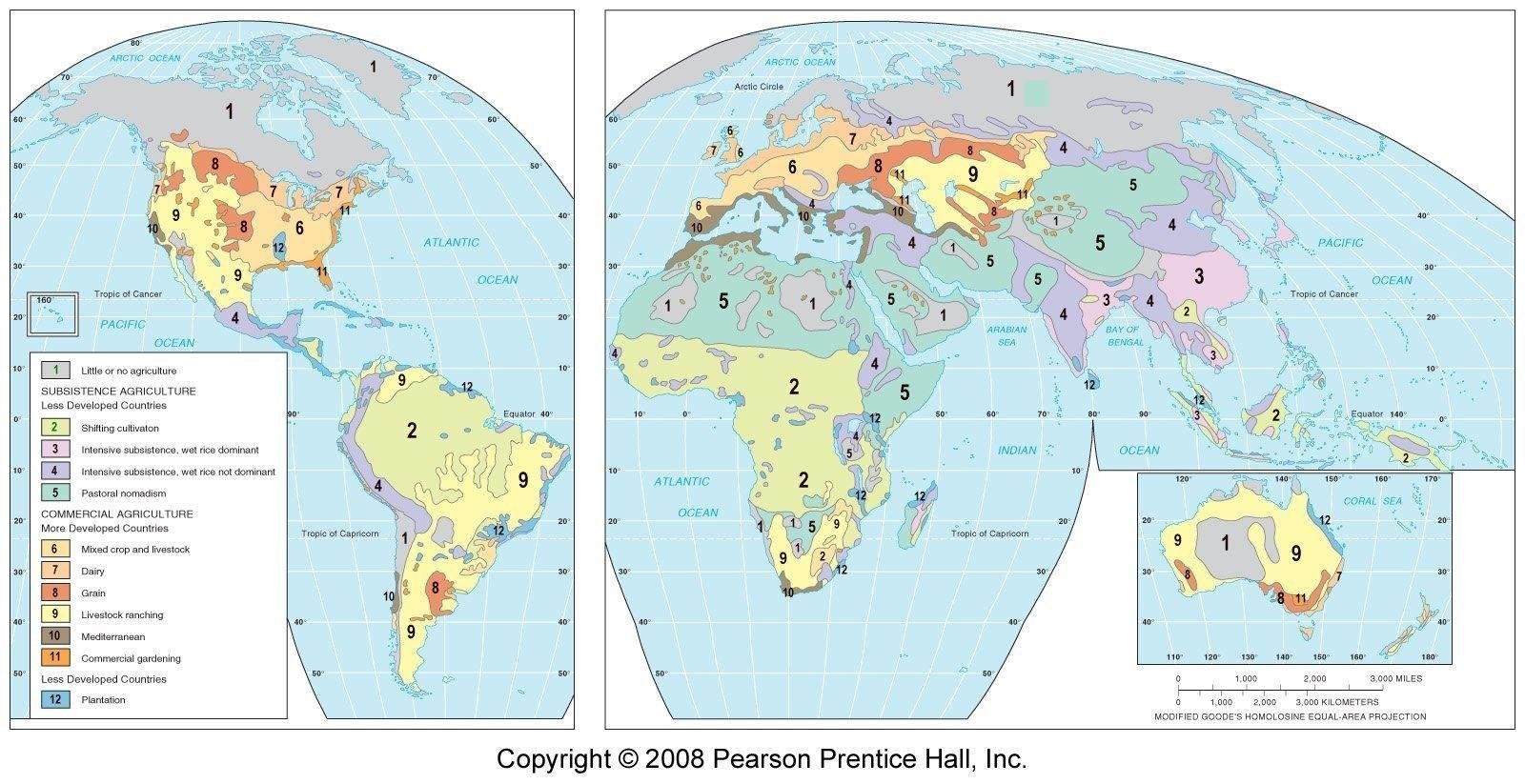
- Read the legend first: 1 little/no agriculture; 2–5 subsistence (LDCs); 6–11 commercial (MDCs); 12 plantation (LDCs). 범례를 먼저 읽는다: 1 농업 거의 없음; 2–5 자급(LDC); 6–11 상업(MDC); 12 플랜테이션(LDC).
- Subsistence: 2 shifting cultivation, 3 wet rice dominant, 4 wet rice not dominant, 5 pastoral nomadism. 자급: 2 이동경작, 3 벼 우세, 4 벼 비우세, 5 유목.
- Commercial: 6 mixed, 7 dairy, 8 grain, 9 livestock ranching, 10 Mediterranean, 11 commercial gardening. 상업: 6 혼합, 7 낙농, 8 곡물, 9 기업적 목축, 10 지중해성, 11 상업적 원예.
⚠ The slide summary says '11 regions' but the F03 legend has 12 items. Use the F03 legend numbers; do not memorize the count 11.
⚠ 슬라이드 요약은 '11개 지역'이라 하지만 F03 범례는 12개 항목이다. F03 범례 번호를 쓰고 개수 11은 외우지 않는다.
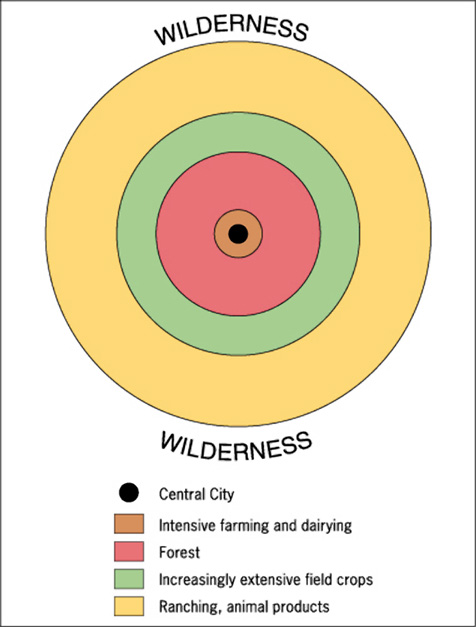
- Center = Central City (market); ring 1 intensive farming and dairying, ring 2 forest, ring 3 increasingly extensive field crops, outer ring ranching; WILDERNESS beyond. 중심 = 중심 도시(시장); 1고리 집약 농업·낙농, 2고리 숲, 3고리 점점 조방적인 밭작물, 바깥 고리 목축; 그 너머는 황야.
- Rule: closer to the market = higher land rent = intensive and perishable; farther = cheaper land = extensive. 규칙: 시장에 가까움 = 높은 지대 = 집약·상하기 쉬운 작물; 멀수록 싼 땅 = 조방.
- Colors in the legend: orange = intensive farming and dairying, red = forest, green = field crops, yellow = ranching. 범례 색: 주황 = 집약 농업·낙농, 빨강 = 숲, 초록 = 밭작물, 노랑 = 목축.
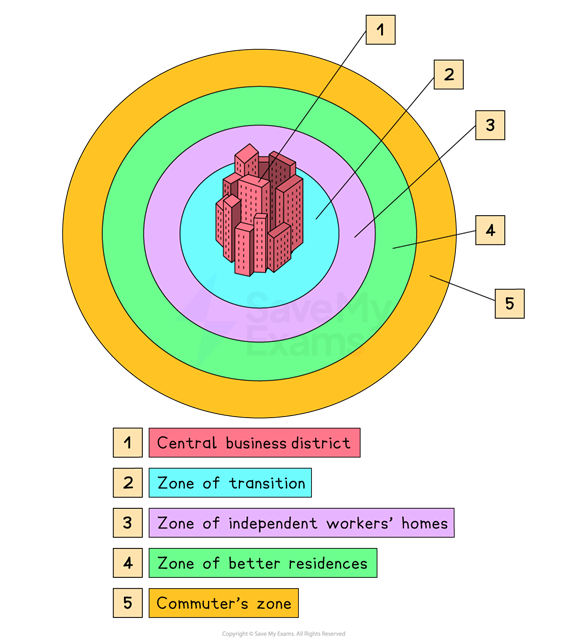
- Count outward from the center: 1 Central business district, 2 Zone of transition, 3 Zone of independent workers' homes, 4 Zone of better residences, 5 Commuter's zone. 중심에서 바깥으로 센다: 1 중심업무지구, 2 전이지대, 3 독립 노동자 주거지대, 4 더 나은 주거지대, 5 통근자 지대.
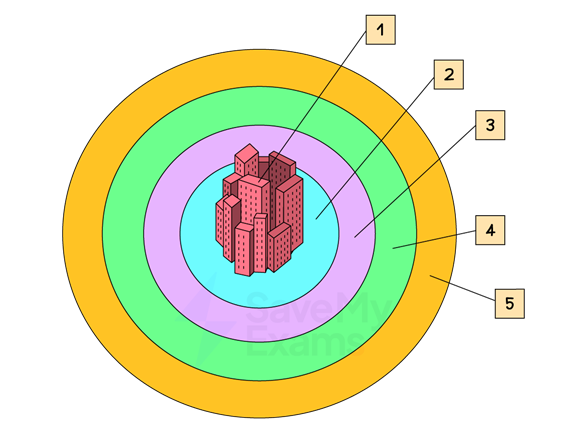
- No legend: number 1 is the center (CBD) and 5 is the outermost ring; match each number to the F28 mapping from memory. 범례 없음: 1번이 중심(CBD)이고 5번이 가장 바깥 고리; 각 번호를 F28 대응표로 외워서 맞춘다.
- Quick test: rent and building height are highest at 1; richest and most spacious housing at 5. 빠른 확인: 지대와 건물 높이는 1번이 가장 높고, 가장 부유하고 넓은 주택은 5번.
⚠ The Chicago 1920s figure (F29) has a six-zone legend (I Loop … VI Commuter zone). For zone-number questions use only the five-zone F28/F32.
⚠ 시카고 1920년대 그림(F29)은 6구역 범례(I 루프 … VI 통근자 지대)이다. 구역 번호 문제는 5구역인 F28/F32만 쓴다.
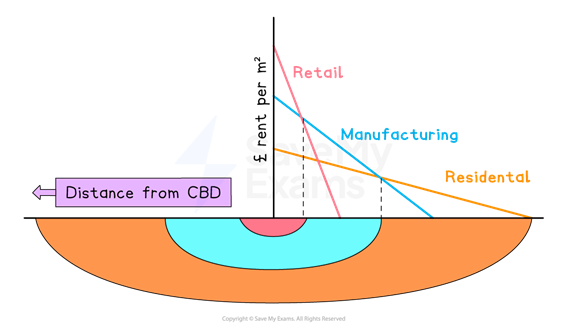
- Retail line is the steepest (highest rent at the CBD), manufacturing is in the middle, residential is the flattest. 소매 선이 가장 가파르다(CBD 지대 최고), 제조는 중간, 주거가 가장 완만하다.
- Read the lines left to right: the use with the highest line at a distance wins that land, so bands form retail (center), manufacturing, residential (outer). 선을 왼쪽에서 오른쪽으로 읽는다: 그 거리에서 가장 높은 선의 용도가 그 땅을 차지하므로 소매(중심), 제조, 주거(외곽) 띠가 생긴다.
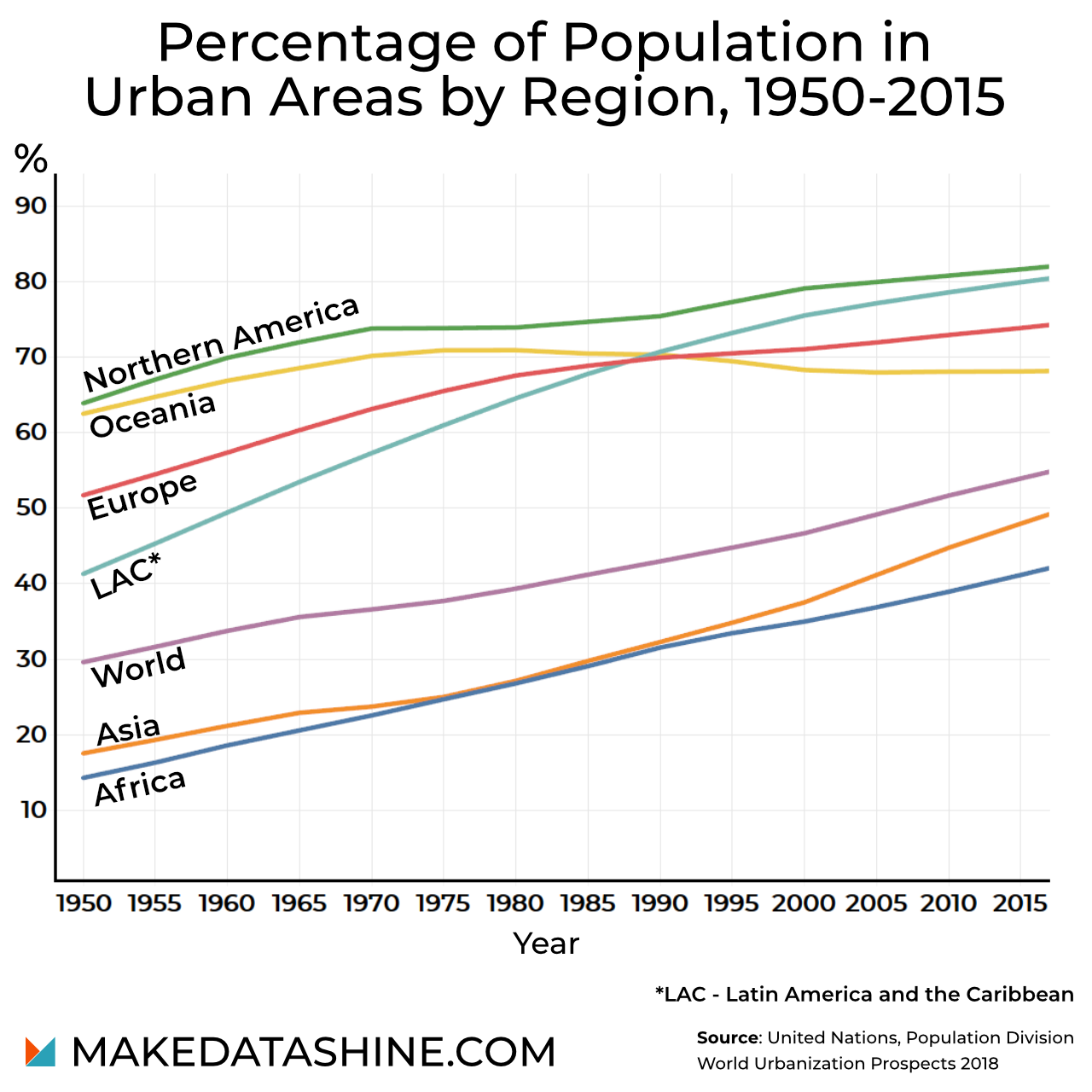
- Ranking in 2015 (approximate): Northern America ~82%, LAC ~80%, Europe ~74%, Oceania ~69%, World ~54%, Asia ~49%, Africa ~41% (lowest). 2015년 순위(근사값): 북아메리카 약 82%, 라틴아메리카·카리브 약 80%, 유럽 약 74%, 오세아니아 약 69%, 세계 약 54%, 아시아 약 49%, 아프리카 약 41%(최저).
- Shape cues: LAC rises steeply; Oceania is flat. Source: UN. 모양 단서: 라틴아메리카·카리브는 가파르게 상승; 오세아니아는 평평. 출처: UN.
Numbers and proper names 숫자·고유명 암기
- Hunter-gatherer bands — fewer than 50 people. 수렵·채집 무리 — 50명 미만. [U5 p3]
- First Agricultural Revolution — around 10,000 BCE, right after the last Ice Age. 제1차 농업혁명 — 약 기원전 10,000년, 마지막 빙하기 직후. [U5 p5]
- Green Revolution dates — ⚠ slide p12: 1950s–1960s; slide p60: 1940s to the 1970s/80s. Do not state one as the answer. 녹색혁명 연대 — ⚠ 슬라이드 12쪽: 1950s–1960s; 60쪽: 1940s–1970s/80s. 하나를 정답으로 단정하지 않는다. [U5 p12,U5 p60]
- Cereals more than doubled in targeted LDCs between 1960 and 1990. 표적 LDC의 곡물 생산이 1960–1990년에 두 배 이상. [U5 p62]
- Green Revolution names: Norman Borlaug; IR8 "Miracle Rice"; India, Mexico, Philippines. 녹색혁명 고유명: 노먼 볼로그; IR8 "기적의 쌀"; 인도·멕시코·필리핀. [U5 p60,U5 p61,U5 p62]
- Place names: Ogallala Aquifer (U.S. Great Plains); Aral Sea; Sahel. 지명: 오갈랄라 대수층(미국 대평원); 아랄해; 사헬. [U5 p65,U5 p66]
- 2017 FRQ Q3 points — A 1, B 1, C 2, D 1, E 1 (total 6); 2019 FRQ — A to F, 1 point each. 2017 FRQ 3번 배점 — A 1, B 1, C 2, D 1, E 1(합 6); 2019 FRQ — A~F 각 1점. [U5 p67,U5 p69]
- Von Thünen: Rings 1–4; Whittlesey legend 1–12 (⚠ not 11). 튀넨: 1–4고리; 휘틀지 범례 1–12(⚠ 11 아님). [U5 p21,U5 p15]
- Urbanization hearths — Mesopotamia, Nile, Indus, Huang He river valleys. 도시화 발상지 — 메소포타미아, 나일, 인더스, 황허 강 유역. [U6a p3]
- MDC urbanization typically 75–80%+. MDC 도시화율은 보통 75–80% 이상. [U6a p7]
- Interstate Highway Act of 1956 (U.S.). 1956년 미국 주간 고속도로법. [U6a p9]
- Megacity > 10 million; metacity > 20 million. 메가시티 > 1천만; 메타시티 > 2천만. [U6a p12]
- 1970s: only eight megacities (Tokyo, Osaka, Seoul, Moscow, New York, Los Angeles, Mexico City, São Paulo). 1970년대: 메가시티는 8개뿐(도쿄·오사카·서울·모스크바·뉴욕·로스앤젤레스·멕시코시티·상파울루). [U6a p14]
- About 80% of megacities are in Asia. 메가시티의 약 80%가 아시아에 있다. [U6a p15]
- Africa: 3 megacities now (Cairo, Kinshasa, Lagos) to 7 by 2050 (add Dar es Salaam, Nairobi, Khartoum, Luanda). 아프리카: 현재 메가시티 3개(카이로·킨샤사·라고스) → 2050년 7개(다르에스살람·나이로비·하르툼·루안다 추가). [U6a p17]
- Dar es Salaam 7.5 million to 16.4 million (+118%); Nairobi 5.2 million to 10.4 million; Cairo 32.6 million (⚠ slide says '32.6 people'); Kinshasa 29 million; Lagos 28.2 million. 다르에스살람 750만 → 1,640만(+118%); 나이로비 520만 → 1,040만; 카이로 3,260만(⚠ 슬라이드는 '32.6 people'로 오기); 킨샤사 2,900만; 라고스 2,820만. [U6a p17]
- By 2050: 70% of the global population in cities (57% today); 14 more megacities; Delhi top at 49.6 million. 2050년: 세계 인구의 70%가 도시 거주(현재 57%); 메가시티 14개 추가; 델리가 4,960만으로 1위. [U6a p19]
- Burgess, 1925; US city of 1900–1950; five zones in F28 (⚠ F29 Chicago shows six). 버제스, 1925; 1900–1950 미국 도시; F28은 5구역(⚠ F29 시카고는 6구역). [U6b p6]
- 40% of all Chicago residents work in the Loop. 시카고 주민 전체의 40%가 루프에서 일한다. [U6b p17]
- Examples: Chicago Loop; Downtown LA (Chinatown, Little Italy inner; Beverly Hills, Malibu outer); Tokyo and Mount Fuji (criticism). 예: 시카고 루프; 다운타운 LA(안쪽 차이나타운·리틀 이탈리아; 바깥 베벌리힐스·말리부); 도쿄와 후지산(비판). [U6b p17,U6b p18]
- Bid-rent theory — William Alonso. 입찰 지대 이론 — 윌리엄 알론소. [U6b p3]